Introduction
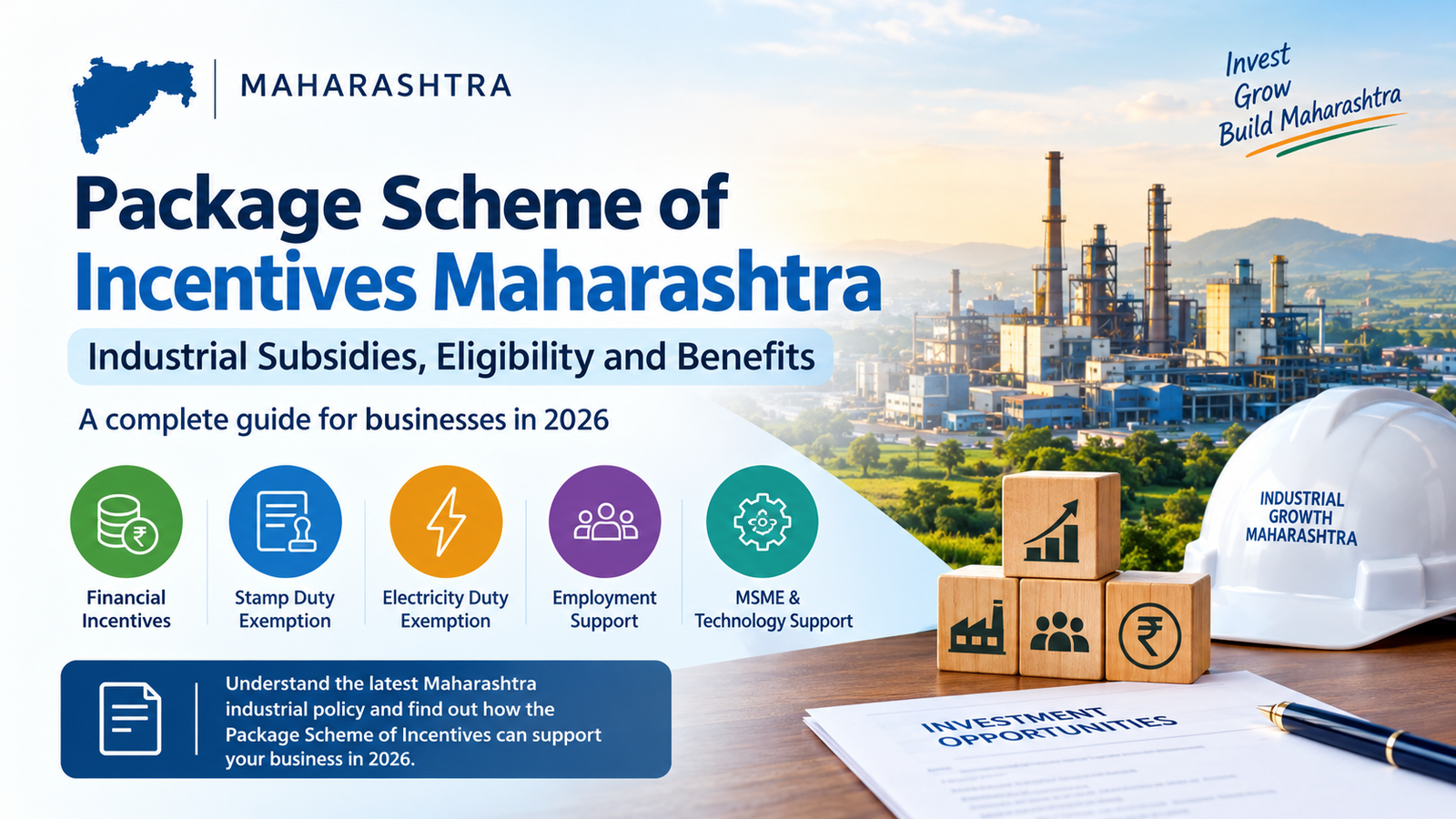
Maharashtra continues to be one of India’s leading destinations for manufacturing, industrial investment and business expansion. To encourage industrial development, generate employment and promote investment in less-developed regions, the Government of Maharashtra has introduced various financial and non-financial incentives for eligible businesses.
The Package Scheme of Incentives (PSI) has historically been an important mechanism for providing industrial subsidies in Maharashtra. The PSI-2019 framework supported eligible industrial units through benefits linked to investment, location, employment and industrial classification.
However, businesses planning a new project or expansion in 2026 should also understand the Maharashtra Industries, Investment & Services Policy 2025, approved by the state government and dated 31 December 2025. The new policy establishes a broader framework for manufacturing and service-sector investment and envisages changes to the state’s incentive scheme.
Consequently, companies should verify the latest applicable government resolutions and implementation guidelines before estimating their subsidy entitlement.
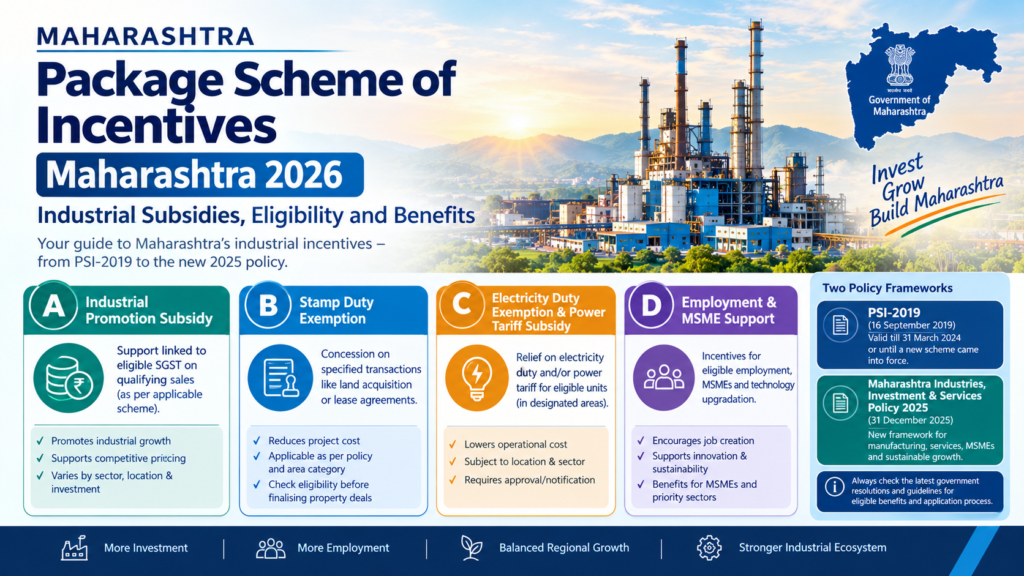
Table of Contents
What Is the Package Scheme of Incentives?
The Package Scheme of Incentives is a Maharashtra government initiative designed to encourage industrial investment, promote balanced regional development and strengthen the competitiveness of eligible enterprises.
Under the earlier PSI-2019 framework, qualifying units could receive incentives depending on their location, investment, size, sector and compliance with scheme conditions.
The broad objectives include:
- Encouraging new industrial units and eligible expansion or diversification projects.
- Promoting investment in developing and underdeveloped regions.
- Supporting eligible micro, small and medium enterprises (MSMEs).
- Generating direct employment and strengthening local industrial ecosystems.
- Encouraging technology adoption, productivity improvements and sustainable industrial development.
The incentives available to an individual business depend on the applicable scheme, eligibility conditions and approval from the competent authority.
Maharashtra Industrial Incentives: PSI-2019 and the 2025 Policy
The PSI-2019 government resolution was issued on 16 September 2019. Its stated operating period was 1 April 2019 to 31 March 2024, or until a new Package Scheme of Incentives came into force.
Maharashtra subsequently approved the Industries, Investment & Services Policy 2025 on 31 December 2025. The policy is intended to strengthen industrial investment, services, MSMEs, advanced manufacturing, employment and sustainable growth.
It also provides for a revised collective incentive scheme aligned with the new policy.
For businesses in 2026, this distinction is important. Existing approvals and earlier applications must be assessed under the provisions applicable to them, while new projects should establish which incentive framework and implementation orders govern their investment.
Do not assume that a benefit, subsidy percentage or eligibility period published under PSI-2019 automatically applies to a new project under the 2025 policy.
Major Incentives Available Under the Industrial Policy Framework
Depending on the applicable scheme and the unit’s eligibility, industrial support may include the following categories.
1. Industrial Promotion Subsidy
Industrial Promotion Subsidy (IPS) has been a major component of Maharashtra’s industrial incentive framework. Under the relevant provisions, the subsidy may be linked to eligible state GST (SGST) payable on qualifying sales of products within Maharashtra.
The amount payable is subject to scheme-specific limits, eligible products, investment criteria, the location category and other conditions.
Businesses should not calculate their expected reimbursement using a generic percentage without checking the applicable government resolution.
2. Stamp Duty Exemption
Eligible industrial projects may qualify for stamp duty concessions on specified transactions, such as qualifying land acquisition or lease documentation.
The extent of the exemption depends on the applicable policy, location, type of project and transaction. Businesses should confirm whether the proposed transaction qualifies before finalising land or property arrangements.
3. Electricity Duty Exemption
Certain eligible units may receive electricity duty exemptions, subject to the applicable policy and the relevant notifications.
Eligibility can depend on location, project classification, ownership conditions and other prescribed requirements. Separate notifications may be required to implement specific benefits.
4. Power Tariff Subsidy
Eligible projects in designated regions may qualify for power tariff assistance. The amount, duration and maximum admissible benefit depend on the relevant scheme provisions.
Since electricity costs can significantly affect manufacturing profitability, businesses should assess this benefit during project planning rather than assume that every industrial unit qualifies.
5. Employment-Linked Incentives
Employment generation is an important element of Maharashtra’s industrial development strategy. Incentive frameworks may link financial support to eligible direct employment, employer provident fund contributions or other prescribed employment conditions.
Businesses should maintain accurate payroll records, employment registers and supporting documents to demonstrate compliance wherever employment-linked incentives apply.
6. MSME and Technology-Upgradation Support
Maharashtra’s newer policy framework also emphasises MSME competitiveness, quality improvement, research and development, technology adoption, energy efficiency and sustainable production.
Depending on the applicable provisions, eligible enterprises may access support for technology upgrades, certification, audits, cleaner production and related activities. Each benefit has its own conditions, limits and documentation requirements.
| Particulars | Package Scheme of Incentives (PSI-2019) | Maharashtra Industries, Investment & Services Policy 2025 |
|---|---|---|
| Policy period | Issued on 16 September 2019, originally covering 1 April 2019 to 31 March 2024, or until a new scheme came into force. | Newer industrial policy dated 31 December 2025. Applicable benefits depend on the relevant policy provisions and implementation guidelines. |
| Main objective | Encourage industrial investment and balanced regional development across Maharashtra. | Promote industrial growth, investment, employment and the development of priority sectors. |
| Area classification | Uses eligible location categories such as A, B, C, D and D+, along with specified special-area categories. | Benefits and eligibility must be checked against the applicable provisions and location classifications under the new policy. |
| Types of support | May include Industrial Promotion Subsidy, stamp-duty exemption, electricity-duty exemption and power-tariff subsidy, subject to eligibility. | Provides a newer policy framework for industrial investment and incentives. Specific benefits depend on the applicable provisions and scheme conditions. |
| Eligibility | Depends on the eligible enterprise, investment, location, activity, commencement date and applicable scheme conditions. | Depends on the relevant policy provisions, eligible sectors, investment criteria and notified implementation rules. |
| Existing approved projects | Previously approved projects should be assessed under their applicable eligibility conditions, approvals and transitional provisions. | Check the new policy’s transition and implementation provisions before assuming that existing approvals or benefits change. |
Important: This table provides a general comparison, not a guarantee of eligibility or benefits. Refer to the official Government of Maharashtra resolutions and applicable implementation guidelines before making an investment or subsidy claim.
How Industrial Location Affects Subsidy Eligibility
Location is a significant factor in Maharashtra’s industrial incentive framework.
Under PSI-2019, industrial areas were classified into categories including A, B, C, D and D+, alongside specified no-industry, Naxalism-affected and aspirational areas. These classifications reflected differences in industrial development and influenced the incentives available to eligible units.
The newer policy continues to use area-based classifications in determining certain benefits, while also introducing updated provisions for emerging districts and priority sectors.
Before purchasing land or leasing an industrial premises, investors should verify the official classification of the exact taluka or location. A district name alone may not be sufficient to establish eligibility.
Who Can Apply for Industrial Incentives?
Eligibility depends on the applicable scheme and the type of business. Potential applicants may include:
- Eligible manufacturing enterprises and MSMEs.
- Qualifying large-scale industrial projects.
- Eligible expansion and diversification projects.
- Projects in designated priority or strategic sectors.
- Qualifying service-sector enterprises covered by the newer policy.
The project must satisfy the relevant investment, location, employment, registration, operational and compliance requirements. Some projects may also require committee-level appraisal or customised approval.
Documents Required for an Industrial Subsidy Application
The exact documents depend on the scheme and application stage. Common requirements may include:
- Business constitution documents and PAN.
- Udyam registration or other applicable industrial registrations.
- GST registration and relevant returns.
- Land ownership, lease and industrial-premises documents.
- Detailed project report and investment estimates.
- Plant and machinery invoices and payment evidence.
- Bank or term-loan documents, where applicable.
- Statutory permissions and environmental approvals.
- Employment, payroll and provident fund records, where relevant.
- Evidence of commencement of commercial production and supporting financial statements.
Applicants should maintain consistent records across project reports, invoices, GST returns and financial statements.
How to Apply for Maharashtra Industrial Subsidies
Businesses should begin by identifying the policy applicable to their project and confirming eligibility with the competent implementing authority.
The usual preparation process involves:
- Confirming the industrial location and applicable area classification.
- Identifying the correct enterprise and project category.
- Assessing eligible investment and proposed employment.
- Preparing the project report and supporting financial records.
- Submitting the prescribed application through the authorised channel.
- Responding to scrutiny, inspection or clarification requests.
- Obtaining the required eligibility or sanction documents.
- Filing claims and maintaining records according to the approved conditions.
Application deadlines, forms and procedures may differ between schemes. Obtain the current requirements from the Maharashtra Industries, Investment & Services Department, the Commissionerate of Industries, the relevant District Industries Centre or MIDC, as applicable.
Why Professional Industrial Subsidy Consultancy Can Help
Industrial incentive applications involve more than completing forms. Businesses may need to assess investment eligibility, classify project expenditure, verify the applicable location category, reconcile GST and financial records, and prepare evidence for inspections and reimbursement claims.
A qualified industrial subsidy consultant can help review project eligibility, identify relevant incentive provisions, organise documentation and monitor compliance obligations.
However, no consultant can guarantee approval or a particular subsidy amount. Final entitlement depends on the applicable government rules and approval by the competent authority.
Conclusion
The Package Scheme of Incentives has played an important role in Maharashtra’s industrial development. In 2026, businesses must consider both the legacy PSI-2019 framework and the newer Industries, Investment & Services Policy 2025 when evaluating industrial subsidies.
The most effective approach is to verify the current scheme, confirm location and project eligibility, prepare accurate investment records and comply with application deadlines.
For businesses establishing or expanding manufacturing operations in Maharashtra, careful incentive planning can support more informed investment decisions and help identify financial assistance for which the project may qualify.
Official reference: Maharashtra Industries, Investment & Services Policy 2025 and government policy documents.